
Ten centimeters in half a century
The level of the Adriatic Sea has been rising faster than the level of any other sea in the last two decades. From 1960 to 2015, the mean sea level along the Slovenian coast rose by 10 cm, which is why the local population has been experiencing increased flooding of the coastal urban zone. According to experts, this phenomenon is attributable to both global sea-level rise and weather conditions in the region.
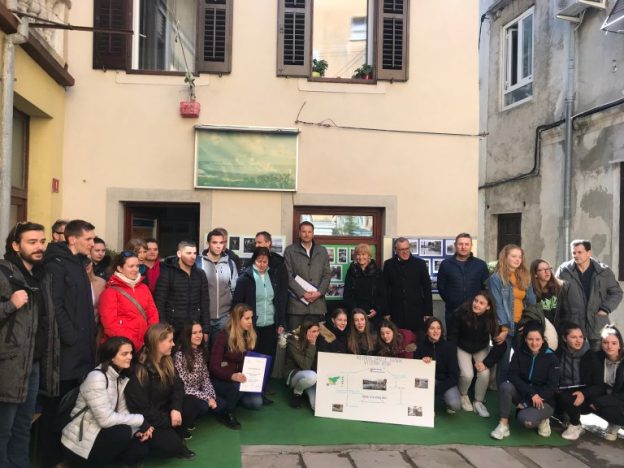
Residents of coastal towns are frequently faced with adverse impact of dynamics of sea and water, usually in the form of flooding of coastal areas. By placing high water marks that show the highest levels reached by the sea during floods, young people from Koper and Piran wished to draw attention to likely future adverse effects of sea and water if communities do not join forces to act in a preventive and active manner and build flood resilience. Izola, another Slovenian coastal town already has a high water mark placed in the backyard of Rex Gallery.
The described work will continue through the 3rd International Conference on 23-24 April 2021 and be a side event of the 6th EUSAIR Forum – Installation of a high-water tablet.
Will you support this great youth initiative to improve our common future? – Register!
Slovenia started its Presidency of the EU Strategy for the Adriatic-Ionian Region with the 2nd International Conference of Geography Teachers – “Climate change adaptation” and wishes to also conclude in the same manner. The 3rd International Conference will take place on 23-24 April 2021 and its purpose will be concluded by a side event of 6th EUSAIR Forum – “Installation of a high water tablet”.